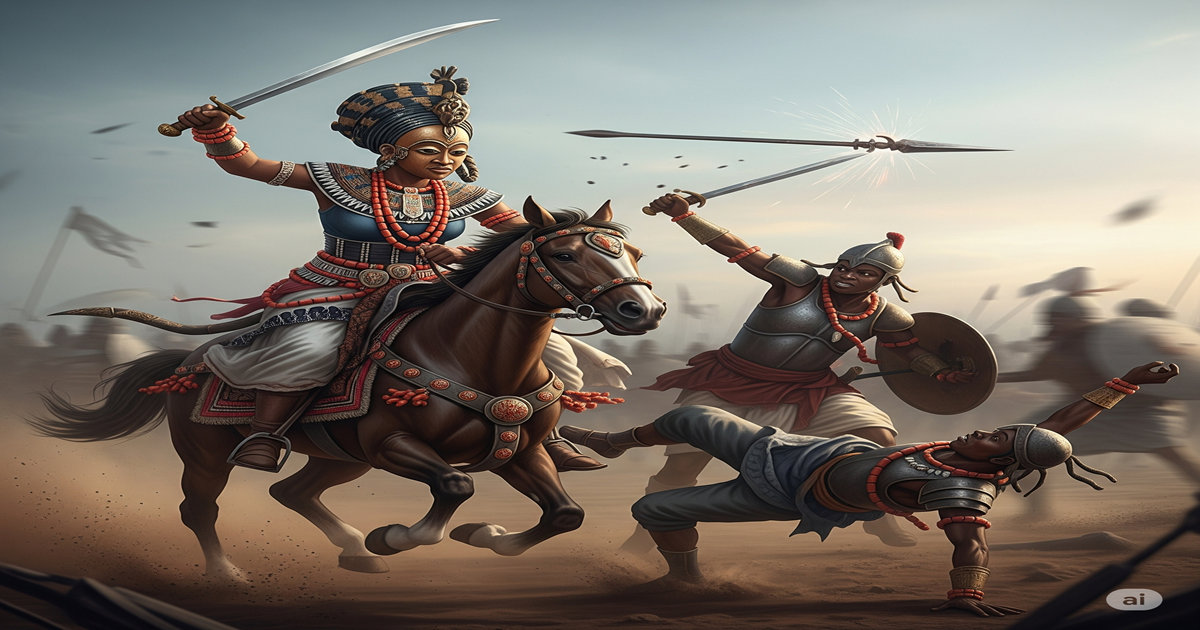
The Queen Idia got ready for battle
A storm was brewing, but not on the horizon—it was a storm of drums, war cries, and the thunderous footfalls of warriors. The air, thick with tension, crackled with the energy of the mystical forces Queen Mother Idia had summoned.
Idia stood on the front lines, a fierce yet serene presence. The ceremonial beads on her regalia rattled with each step, a sound like dry bones marching to battle. Her gaze was fixed, not on the enemy, but on her own men, her son, King Esigie, at the head of the charge. She felt their courage, a tangible force she had fortified with her sacred elixir. The warriors, their bodies tingling with otherworldly strength, gripped their weapons with a newfound ferocity.
Across the field, the Igala army, a vast and formidable force, unleashed a volley of spears and arrows. They expected to see fear, to hear the Benins falter. Instead, they were met with an unyielding wall of men who seemed to move faster, hit harder, and bear the onslaught without a scratch.
The sacred elixir was working its magic. Idia’s incantations, a low murmur on her lips, wove through the battlefield, confusing the enemy and empowering her own. She watched as a Benin warrior, struck by a spear, brushed the weapon aside as if it were a branch. The Igala, their confidence shaken, stared in disbelief.
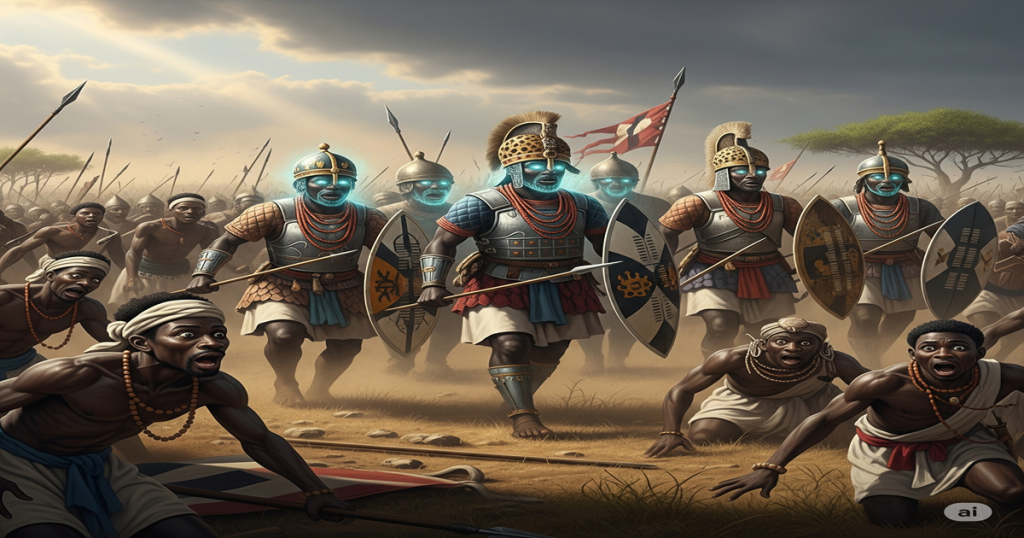
With a powerful war cry, Esigie led the final charge. The clash of steel was deafening, but it was a one-sided symphony. The Benin forces, fueled by a power they didn’t fully understand, fought with the precision of a well-oiled machine. The Igala, their initial confidence replaced by terror, fell back in disarray. They had not just fought a king and his men; they had fought a force of nature, guided by the divine will of Queen Mother Idia.
Victory was not just won; it was earned in a battle that would be forever remembered as a testament to the might of the Benin Kingdom and the extraordinary power of its queen mother.
As the Igala army breaks, their retreat becomes a rout. Queen Mother Idia, not content to let the victory be incomplete, spurs her horse into a charge. Her sword, a flash of steel in her hand, is drawn.
The Queen Mother’s Fury
The air, once thick with the clash of weapons, is now filled with the frantic cries of the retreating Igala. They run in a disorganized mass, their backs turned to the kingdom they failed to conquer. But a new sound emerges from the Benins’ lines: the thunder of a single horse, ridden by a figure of majestic fury.
It is Queen Mother Idia, her regalia a blur of color, her eyes blazing with a warrior’s fire. She rides faster than any man, a divine fury propelling her forward. She catches the fleeing soldiers with frightening speed, her sword a deadly extension of her will. With a single, fluid motion, she disarms one man, sending his weapon spinning through the air. With a second strike, she forces another to the ground.
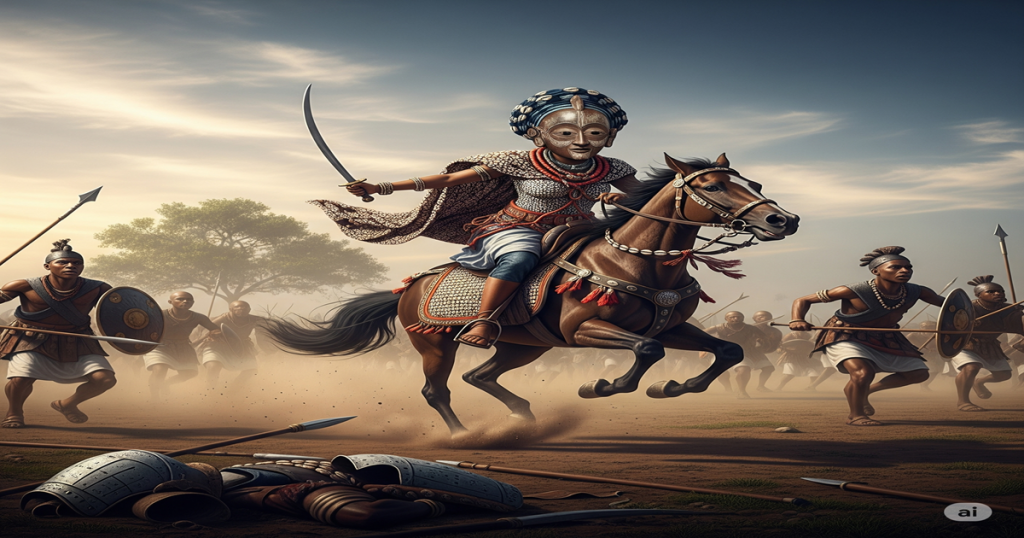
Her son, King Esigie, and the Benin army watch in awe and inspiration. They had seen her magic, but never her physical prowess. A roar of renewed energy erupts from their throats. They follow her into the fray, no longer just a pursuing army but a force of nature.
Idia dismounts in the midst of the retreating soldiers, her horse a powerful specter behind her. She becomes a whirlwind of motion, her sword a blur of light. She fights with the grace of a dancer and the power of a tempest, using both her sword and the ancient martial arts of her people. With a swift kick, she sends a warrior stumbling backward. With a block and a pivot, she fells another with the flat of her blade.
Fear, a cold, icy dread, spreads through the Igala ranks. They are not fighting a woman; they are fighting a goddess. The tale of her might would forever be etched in their memories, a stark warning never to challenge the Benin people or their lands again.
The battlefield, now silent, was a tableau of Benin’s triumph. King Esigie, his armor streaked with sweat and victory, turned to his most trusted general.
“Osagie,” he commanded, his voice ringing out across the field. “Take a legion and bring the captured Igala soldiers to the palace. They must witness the might of the Oba and the mercy of Benin.”
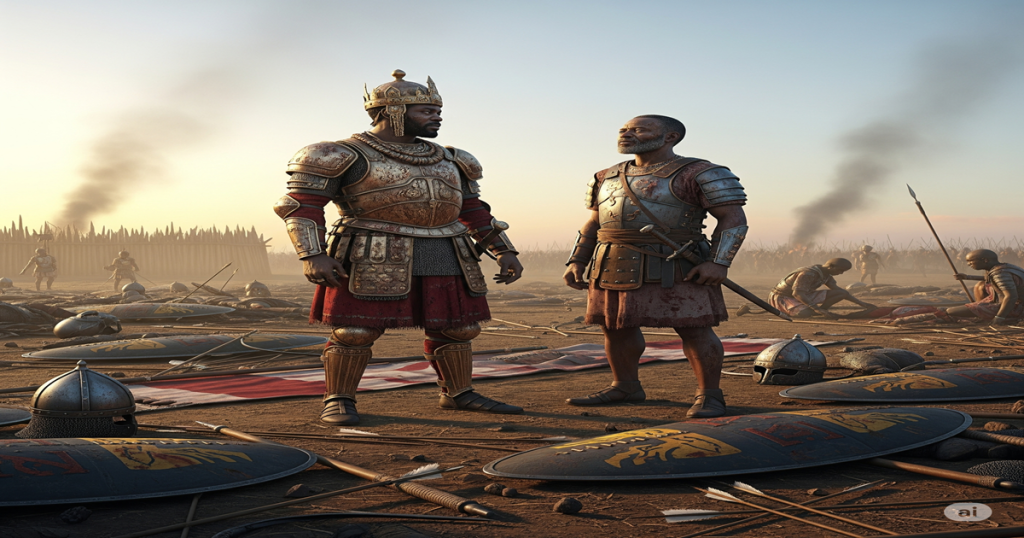
Returning to the palace victoriously
With the order given, the king turned to his mother. Side by side, they began their procession back home, their returning soldiers a powerful escort. As they marched, the defeated landscape gave way to the familiar path to the royal city, a path now hallowed by their victory.
The soldiers, their faces still hardened from combat, looked at Queen Mother Idia with a newfound awe. They had seen her magic; they had witnessed her fight. She was more than just a royal figure; she was their protector, their warrior queen. One by one, a low murmur rose among their ranks, growing into a unified, thunderous chant.
“Hail High Queen Idia!” they cried, their voices a single, powerful wave of veneration. The sound was deafening, a tribute to her supernatural prowess and her fierce courage. Only after they had honored her did their loyalty turn to their king, as the chant shifted to a powerful roar: “Hail the king!”
Days after the thunderous clash that had secured Benin’s borders, the air within the palace court was still and heavy with the weight of victory. King Esigie sat upon the throne of his ancestors, a figure of radiant authority. Beside him, General Osagie stood like a carved sentinel of bronze, his face a testament to the battle he had commanded.
The Power of Mercy
With a powerful gesture, the king gave the order, and the grand doors of the court swung open. The conquered Igala army was led inside, their once-proud banners now tattered and forgotten. They were a humbled legion, their heads bowed low as they were forced to their knees. At their front, their commander, a man named Iga, lay prostrate, his spirit as broken as his army.
“My lord, King Esigie, Oba of Benin,” Iga’s voice trembled, a desperate plea echoing through the solemn chamber. “We were fools to challenge your divine might. We beg for the mercy of your hand.”
As Iga’s words hung in the air, a royal messenger hurried into the court. He whispered into the ear of a seated chief, whose eyes widened in awe. The chief, with a profound and humble reverence, quickly rose and addressed the throne.
“My King,” he announced, his voice carrying the weight of the moment, “The Queen Mother has arrived.”
A palpable hush fell over the court. The heavy doors opened once more, and Queen Mother Idia entered. Her presence was a force of nature, her wisdom and power so vast that they filled the hall. She moved with a serene dignity and took her seat, her gaze fixed on the pleading commander. She listened, her silence a judgment in itself.
King Esigie looked at his mother, a glorious, confident smile gracing his lips. Idia met his gaze and, with a subtle but powerful nod, granted her silent approval.
The king’s voice then boomed across the chamber. “The Benin people are a people of peace and mercy. As such, I, King Esigie, grant you and your army your lives. You are free to return to your lands.”
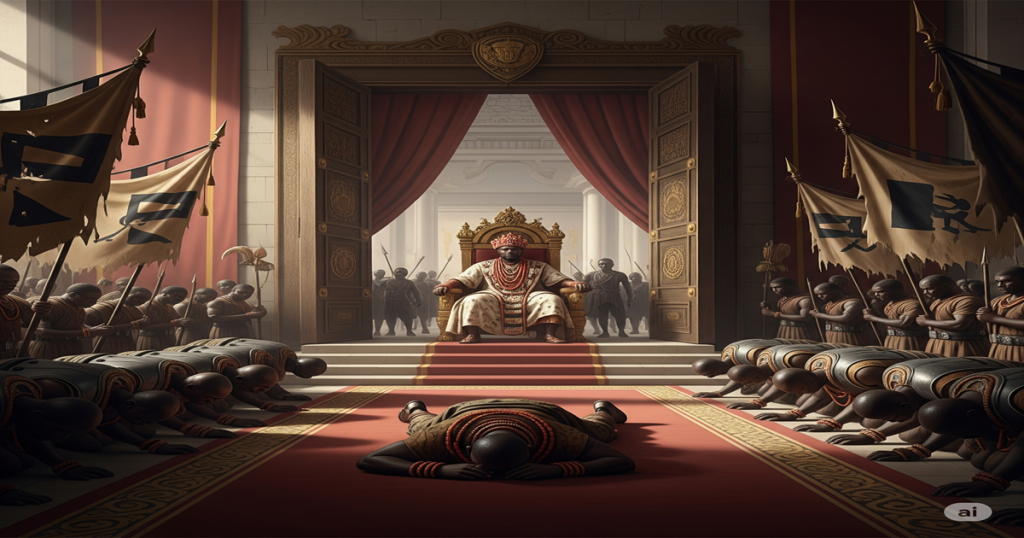
A wave of overwhelming joy swept through the Igala prisoners. Their commander, Iga, fell to the ground, touching his head to the cold floor in a gesture of profound gratitude. “Thank you, my lord!” he cried. “Thank you!”
King Esigie raised a hand, his voice continuing with a final command. “But you will return to your ruler and tell him to come before me. He shall pay homage to the throne of Benin and swear to remain a subject of this kingdom. Never again will your people wage war on our lands.”
“Yes, my lord King,” Iga promised, his voice filled with newfound hope. “It will be done.”
The End.